- Located at Ezhimala, in the Kannur district of the state of Kerala, Indian NavalAcademy (INA)is amongstthe premierarmed forces institutions our;country. It is through the allowed portals of the INA that all officer-trainees joining the Indian Navy and the Indian Coast Guard pass out, in their progression to join the officer-corps of respective services. The academy follows a system of holistic training that caters to the physical, intellectual and socio-cultural development of each cadet. In preparing its trainees for the myriad challenges of military leadership that they will encounter at sea, on land, in the air, as also in both ‘outer’ and ‘inner’ (cyber) space, the INAactively promotes academic and professional excellence.
- Namedafter the historic Mount Dilli hill locatedwithin;INA premises, the‘DilliSeries'Sea Power Seminar is conducted at INA during Autumn Term (October) every year.
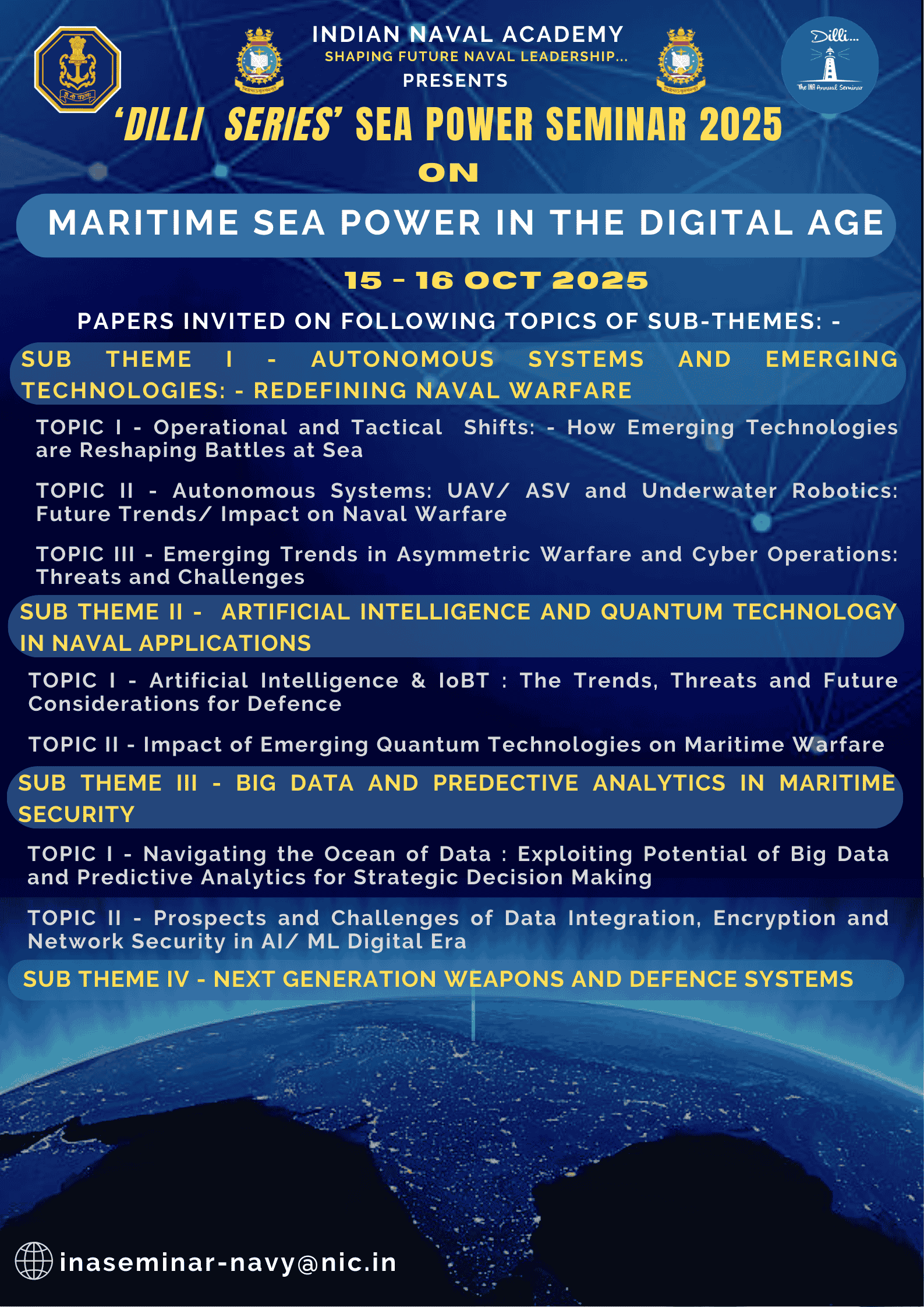
- The theme of the twelfth edition of the seminar to be held at INA on 15-16 Oct 25, is ‘Maritime Sea Power in Digital Age’. The seminar is expected to shed light on the evolving dynamics of modern maritime warfare and also the ongoing research and futuristic technologies capable of reshaping and redefining the future of sea power. Papers are invited from serving as well as retired officers, academia and industrial professionals on the following sub-themes: -
- Autonomous Systems and Emerging Technologies: Redefining Naval Warfare.
- Artificial Intelligence and Quantum Technology in Naval Applications.
- Big Data and Predictive Analytics in Maritime Security.
- Next Generation Weapons and Defence Systems.
Note: Details of topics under each sub-theme are mentioned on subsequent pages
- Selection of Papers.
- Only selected papers shall be presented during the Seminar.
- From the remaining papers received, the papers with requisite quality and content will be published in the Seminar Compendium.
- Authors of selected papers will be intimated post scrutiny of papers.
- Instructions for Authors. Soft copies of synopsis (250-300 words) and final paper (3000 to 5000 words) along with the author’s biodata, passport size photo and security clearance/ author’s certificate as per the guideline enclosed are to be forwarded by e-mail at inaseminar-navy@nic.in by 21 Jul 25.
Contact Details
Head of the Faculty Telephone/ Fax: 04985-223855
Faculty of Basic Sciences and Humanities E-mail: inaseminar-navy@nic.in
Indian Naval Academy
Ezhimala, Naval Academy PO
District: Kannur, Kerala- 670310
- Considering that the seminar is primarily for the benefit of trainees at INA, it is expected that the papers apart from being intellectually stimulating, thought provoking and rich in academic rigour, would also cater for the envisaged learning outcome for the trainees as mentioned against each topic.
SUB-THEME I
AUTONOMOUS SYSTEMS AND EMERGNG TECHNOLOGIES: REDIFINING NAVAL WARFARE
- Naval warfare is transforming as emerging technologies and autonomous systems reshape traditional operational strategies. The shift from Platform-centric to Network-centric warfare reflects the growing importance of speed, adaptability and real-time decision-making capability in maritime domain.Artificial Intelligence (AI) and Machine Learning are at the forefront of this transformation and real-time data analysis from multi-domain sensors and improving situational awareness to assess evolving threats instantly.
- The integration of autonomous platforms in naval domains - such as Unmanned Aerial Vehicles (UAVs)/ Autonomous underwater vehicles perform critical roles in Intelligence, Surveillance and Reconnaissance (ISR), Anti-submarine Warfare and amphibious support. Future trends suggest a rise in swarm technology, enhanced autonomy, underwater robotic networks and AI-enabled payloads, which will significantly strengthen fleet lethality, survivability and reach.
- At the tactical level, AI-powered Combat Management Systems (CMS) and battle networks are revolutionising maritime decision-making. These systems integrate satellites, sonar, radar and electronic surveillance inputs, providing a fused operational picture to commanders in real-time. AI-enhanced guidance systems are transforming precision-strike capabilities - supporting hypersonic missile development, autonomous targeting and adaptive trajectory correction. Furthermore, emerging propulsion and energy systems such as Electromagnetic Railguns and Directed Energy Weapons are being developed with these intelligent systems, offering a glimpse into next-generation naval firepower.
- However, these technological advances also expose navies to asymmetric and cyber threats. Adversaries leverage low-cost autonomous drones, cyber tools and Electronic Warfare systems to challenge conventional naval superiority. AI-enabled cyber intrusions now pose a credible threat to communication networks, satellite-links and automated control systems. Electronic Counter Measures can jam sensors, spoof targeting systems or disrupt GPS navigation - undermining the effectiveness of even the most advanced platforms. The evolving nature of asymmetric warfare demands resilient cybersecurity architecture, hardened AI models against adversarial manipulation and robust command and control structures.
- Looking into the future, the convergence of AI, Quantum Computing and advanced propulsion technologies is set to redefine the global maritime battlespace. Autonomous combat systems operating across the seas, airspace and cyber domains will lead to integrated, multi- domain operations characterised by decentralised command and precision coordination. However, this future is not without challenges. Ethical concerns over legal autonomy, ambiguity in unmanned warfare, adversarial AI exploitation and the need for human-in-the-loop decision- making highlights the complexity of this evolution.
Topics and Learning Outcomes.
- Papers are invited on the following topics: -
Ser | Topic | Learning Outcomes for Trainees |
(a) | Operational and Tactical Shifts: How Emerging Technologies are Reshaping Battles at Sea. | - Understand how technological innovation alters traditional naval operational and tactical paradigms.
- Evaluate the potential advantages and vulnerabilities introduced by new technologies at sea.
- Analyse case studies where emerging technologies have influenced recent maritime engagements.
|
(b) | Autonomous Systems: UAV/ ASV and Underwater Robotics: Future Trends/ Impact in Naval Warfare. | - Describe the functions and capabilities of UAVs, ASVs, and underwater robotic systems
- Interpret future trends in autonomous naval systems and predict their battlefield implications
- Assess the operational advantages and ethical considerations of deploying autonomous systems.
|
(c) | Emerging Trends in Asymmetric Warfare and Cyber Operations: Threats and Challenges. | - Identify key characteristics and examples of asymmetric threats and cyber operations in maritime contexts.
- Explain how cybercapabilities can be used offensively and defensively in naval warfare.
- Comprehend the challenges of countering non-traditional threats in the maritime domain.
|
SUB-THEME II
ARTIFICIAL INTELLIGENCE AND QUANTUM TRECHNOLOGY IN NAVAL APPLICATIONS
- Naval operations are witnessing a paradigm shift as Artificial Intelligence (AI) and Quantum Technologies redefine how maritime forces operate, analyse, and respond. AI drives rapid automation and decision-making across domains - enabling real-time threat detection, autonomous platform control, adaptive battle planning and predictive maintenance. Simultaneously, the emergence of the Internet of Battlefield Things (IoBT) is connecting every element of the battlespace - ships, UAVs, AUVs, satellites, and sensorsinto a coordinated and self-aware network. These intelligent, interconnected systems exponentially enhance situational awareness, speed of response, and operational reach, offering a new edge in naval command and control.
- The proliferation of IoBT in naval environment introduces both transformational advantages and significant threats. AI-enabled IoBT systems can independently assess threat environments, share data across platforms and initiate defensive or offensive actions without constant human input. However,these networks also expand the attack& surface for adversaries. Cybersecurity becomes critical as adversarial algorithms can deceive AI models and autonomous IoBT nodes can be spoofed, hijacked or jammed. Ensuring resilient and secure communications, trusted AI models and hardened decision-making frameworks will be central to future-proofing naval networks against Electronic and Cyber Warfare.
- As AI continues to evolve, Quantum Computing is poised to revolutionise data processing in the maritime battlefield space. Naval platforms generate immense data from sonar, radar, ISR drones and satellites etc. Classical computing struggles with the complexity and volume of this data in real-time - whereas quantum systems can process vast, multidimensional datasets simultaneously. Quantum algorithms will enhance threat correlation, improve cryptographic systems, optimise logistical chains and, offering faster decision loops and an unmatched advantage in high-speed, data-dense maritime operations. The fusion of AI with quantum computing can unlock exponential improvements in fields like autonomous navigation, submarine detection, missile defence etc.
The convergence of AI and quantum technologies will enable a new era of intelligent, resilient, and autonomous naval warfare. From unmanned swarms guided by Quantum- Enhanced AI to real-time battlefield simulations and secure strategic command. These technologies will reshape and redefine doctrines, tactics, and global maritime balances. However, ethical, legal, and doctrinal frameworks must evolve in tandem, ensuring human
- Papers are invited on the following topics: -
Ser | Topic | Learning Outcomes for Trainees |
(a) | Artificial Intelligence and IoBT: The Trends, Threats and Future Considerations for Defence | - Explain the concepts of Artificial Intelligence (AI) and theInternet of Battlefield Things (IoBT) and their relevance to modern warfare.
- Analyse current trends and emerging applications of AI and IoBTin defence andmaritime operations.
- Evaluate potential vulnerabilities and threats associated with integration of AI and IoBT in naval systems.
|
(b) | Impact of Emerging Quantum Technologies on Maritime Warfare. | - Understand the basic principles of quantum computing, quantum sensing, and quantum communication.
- Assess how quantum technologies could disrupt or enhance maritime operational capabilities.
- Identify the potential strategic advantages and risks quantum breakthroughs could create in naval warfare.
|
SUB-THEME III
BIG DATA AND PREDECTIVE ANALYTICS IN MARITIME SECURITY
- Big Data and predictive analytics fundamentally transform maritime security by enabling unprecedented situational awareness, operational efficiency and strategic foresight. Modern naval operations have become increasingly dependent on real-time intelligence with the exponential growth of data generated from satellites, radar networks, Autonomous Identification Systems (AIS), sonar and unmanned platforms. Navigating and exploiting this vast ocean of data has become critical for ensuring maritime security, allowing naval forces to detect, analyse and respond to threats with greater precision.
- Traditional tracking and threat assessment methods, which relied on historical trends and manual monitoring, are rapidly being replaced by AI-driven predictive models that can process multi-source intelligence, detect anomalies and anticipate emerging risks. This capability is vital in countering unauthorised incursions, piracy and smuggling while enhancing naval readiness against adversarial manoeuvres, submarine threats and Electronic Warfare tactics.
- One of the most significant advantages of Big Data lies in its ability to drive strategic decision-making by leveraging predictive analytics. Data driven analysis of vessel behaviour and environmental factors enables predictive modelling of potential security threats. This predictive capability enables naval forces to pre-emptively identify high-risk areas, optimise fleet deployment and allocate resources more efficiently.
- The convergence of AI and multi-sensor analytics also enhances Anti-Submarine Warfare by processing acoustic signatures and oceanographic data, significantly improving the ability to detect and track stealth threats. This shift from reactive to predictive security measures represents a fundamental transformation in naval strategy, ensuring that decision-making is faster, more data-driven and adaptive to evolving threats.
- Beyond security operations, Big Data is driving a paradigm shift in naval communication and Electronic Warfare (EW) systems. The modern battlespace is saturated with electromagnetic signals, making it increasingly complex to maintain, secure and resilient networks. Cognitive radio technology, powered by AI and Big Data Analytics, is emerging as a game-changer in Electronic Warfare. Integrating multi-sensor data analysis into EW systems enhances real-time threat detection and response. The ability to anticipate and counter electronic threats in real-time ensures that naval operations remain resilient against adversarial EW strategies, reinforcing maritime superiority in an increasingly digitised battlespace.
- As maritime security is becoming increasingly complex, the nations that successfully integrate Big Data and Predictive Analytics into their naval strategies will gain a decisive edge in future conflicts. The ability to harness real-time intelligence, optimise operational workflows, and enhance Electronic Warfare capabilities will be critical in shaping global naval power dynamics. The fusion of AI, cognitive radio and multi-sensor analytics into maritime security frameworks is not just a technological evolution - it is a fundamental transformation redefining the nature of naval warfare. In an era where information dominance is the key to strategic superiority, the ability to process vast amounts of data and extract actionable intelligence will determine how naval forces can effectively anticipate, adapt, and prevail in the battlespaces of the future.
Papers are invited on the following topics: -
Ser | Topic | Learning Outcomes for Trainees |
(a) | Navigating the Ocean of Data: Exploiting Potential of Big Data and Predictive Analytics for Strategic Decision Making. | - Understand the role of big dataand predictive analytics in enhancing maritime operational awareness and strategic decision-making.
- Interpret key concepts like data mining, trend analysis, and predictive modelling in the naval context.
- Evaluate case studies where data-driven insights improved mission outcomes or readiness.
|
(b) | Prospects and Challenges of Data Integration, Encryption and Network Security in AI/ ML Digital Era. | - Explain the importance of secure data integration and encryption in AI/ML-driven military operations.
- Identify major vulnerabilities and cyber risks associated with AI/MLtechnologies in themaritime domain.
- Understand current and emerging network security strategies aimed at safeguarding sensitive naval data.
|
SUB-THEME IV
NEXT GENERATION WEAPONS AND DEFENCE SYSTEM
- In the digital age, the contours of maritime warfare are undergoing a transformational shift, driven by rapid advancements in technology and multi-domain security threats. Next- generation weapons and defence systems have emerged as the backbone of modern sea power, significantly enhancing a nation’s ability to project maritime influence, defend strategic interests and deter potential adversaries across vast and contested oceanic spaces.
- One of the most significant developments in this realm is the proliferation of Autonomous Naval platforms. Unmanned Surface Vessels (USVs), Unmanned Underwater Vehicles (UUVs) and AI-driven autonomous drones are revolutionising naval operations by conducting high risk tasks such as surveillance, reconnaissance and even offensive missions without endangering human life. When deployed in coordinated swarms, these platforms possess the potential to overwhelm enemy defences through numbers and speed, redefining tactical engagements at sea.
- Complementing these advancements are hypersonic and directed energy weapons, which are reshaping the offensive and defensive landscape of maritime combat. Hypersonic missiles, capable of traveling at speeds exceeding Mach 5, compress decision making windows to mere seconds, making traditional defence systems nearly obsolete. In parallel, the development of directed energy weapons such as high-energy lasers and microwave systems is gaining momentum.
- Modern warships increasingly rely on Integrated Combat Management Systems (CMS) and advanced sensor fusion technologies. These systems consolidate real time data from radars, sonar arrays, satellite feeds and electronic warfare sensors to give a comprehensive battlespace picture.
- In an era where the battlespace extends into the cyber and electromagnetic domains, Cyber Warfare and Electronic Warfare (EW) capabilities have become vital components of maritime defence. Modern naval vessels are now equipped to detect, disrupt and counteract cyber intrusions while simultaneously possessing the capability to jam enemy communications, turn off sensors and protect critical on-board systems.
- Another leap forward is incorporating Quantum Technologies and Artificial Intelligence (AI). Quantum navigation systems promise unmatched accuracy in GPS denied environments. At the same time, AI is being harnessed to enhance threat detection, automate logistics, assist in predictive maintenance and support mission planning. The synergy between AI and Big Data Analytics also transforms strategic forecasting, allowing navies to anticipate and prepare for threats with unprecedented speed and precision.
- The integration of next generation weapons and defence systems is redefining the concept of maritime power in the digital age. Digital superiority, multi-domain integration and technological adaptability are now as critical as traditional firepower in asserting control and maintaining deterrence at sea. For forward looking navies such as the Indian Navy, embracing these innovations is not merely a strategic option but a necessity and crucial for ensuring dominance in blue-water operations and safeguarding national interests.
8. Papers are invited on Next Generation Weapons and Defence System with following learning outcomes for the trainees: -
- Explain the key technologies driving the development of next generation weapons and defence systems.
- Describe the operational characteristics and strategic implications of emerging systems such as autonomous weapons directed energy weapons hypersonic missiles, and quantum-enabled devices.
- Analyse the challenges and opportunities associated with integrating AI, machine learning, and big data analytics into modern weapons platforms.
SUBMISSION GUIDELINES
Contributors are requested to follow the Guidelines given below: -
- The paper should be composed in 12 point Arial single spaced font for the main body of the text, and 10.5 point Arial single spaced font for footnotes using MS Word 2003 and above. The tentative length of the paper should be 2000 – 5000 words (excluding footnotes, acknowledgements, title and sub title). Use footnotes at the end of each page.
- An Abstract of about 200-300 words should be included to describe the main argument and the conclusions of the paper. The Abstract cannot contain footnote references.
- The first sheet should carry details of the author’s biodata (a brief resume of about 200 words), institutional affiliation, a passport-size photograph and the mailing and email address.
A Certificate of Authenticity, countersigned by the author, with the following details should accompany the paper:
“The paper is the original effort of (author’s name, rank, personal number) and the undersigned hereby attest that all material (tables, figures, diagrams, arguments) from primary and secondary sources has been duly cited. The paper bears no Plagiarism in any form. The paper has not been sent to any other publication and has not appeared in print or electronic medium before. The text of the paper does not contain any material above Unclassified.
- All diagrams, charts and graphs should be referred to as Figures and consecutively numbered (Fig.1, Fig.2, and so on). Tables should carry only essential data and should complement the text rather that repeat what has already been said. They should carry a short title, be numbered (Table 1) and carry the source at the bottom.
- Each table must be referenced in the text. If actual statements or phrases are taken from another paper, the name of the author should be mentioned in the text and the chosen material should be placed within quotation marks with an appropriate reference. Alternatively, if another author’s views are to be summarized, use the formulations: ‘The views of xyz are summarized’; give a crisp summary. It is a good practice to reference sources of information extensively and effectively.
- Author’s acknowledgments(s) may be included at the end of the paper and before References/ Endnotes begin.
- The paper should have sub-headings to make it more reader-friendly.
Base Style Guide
- Use short, crisp sentences; they add to readability.
- Use British spelling (colour, organisation, etc).
- Write dates in the following format: for 12 September 2018, write 12 Sep 18. However, for dates 20th century and below i.e. 17 February 1818, write 17 Feb 1818, or for 12 December 1621, write it as 12 Dec 1621.
- In the text, write numbers in words till the number nine and then in numerals (e.g. two, four, nine; then 10,11,12 and so on).
- Write ‘per cent’ and not % or percent.
- Acronyms should carry the full form at the first mention with the acronym in bracket; and thereafter, the abbreviated version. For eg. The United Nations (UN) declared that…Thereafter, the UN did not…
- Names of books, journals, newspapers and foreign term in the body of the text should appear in italics, eg: Asian Security in the 21st Century, Strategic Analysis, The Hindu.
- While referring to currency, use ₹2,000 crores, not 2000 crores of rupees. Similarly,
- $ 8.5 million, nor 8.5 million dollars.
- Use lower case while referring to establishments like the government, the army, and so on. Use upper case if these are accompanied by the name of the country (e.g; the Indian Government or the Chinese Army). The president or prime minister stays lower, unless they are accompanied by the name (eg: Prime Minister Tony Blair or External Affairs Minister Natwar Singh)
References/ Endnotes
- References/ Endnotes should be sequentially numbered.
- The authors are responsible for accuracy of the reference.
- Following is to be kept in mind while citing the works in references: -
While referring to a book, follow the example below:
Padmaja Murthy, Managing Suspicions: Understanding India’s Relations with Bangladesh, Bhutan, Nepal, Sri Lanka, Knowledge World, New Delhi, 2000, pp.59-67.
While referring to a chapter in a book:
Meena Singh Roy, “Building a peaceful Asia, in Jasjit Singh, Reshaping Asian Security, Knowledge World, New Delhi, 2001, pp. 348-61
While referring to a paper in a journal:
P.R. Rajeshwari, “Bill Richardson’s Visit South Asia: A New Phase in US-South Asia Relations”, Journal of Strategic Affairs, 36(19), May 2, 1988, pp. 26-26.
While referring to a paper presented at a conference:
R.V. Phadke, “Security of Energy,” Paper presented at the International Conference on Oil and Gas in India’s Security, New Delhi, 2001, pp. 82-86. Institute for Defence Studies and Analysis, New Delhi, 2001.
While referring to an article in a newspaper: -
Kulbir Krishan, “The Pearl Abduction: who and why?” Pioneer, New Delhi, February 12, 2002, p.7.
While referring to a website: -
“India surpassed Japan to become the word’s fourth largest economy marking a major milestone in its economic journey,” at www.clw.org/pub/clw/economy/power052099.htm (Accessed February 2, 2025)
- If two successive citations/ references refer to the same source, use Ibid.
- If the same reference is to be cited after a few other references/ citations, write the name of the author followed by the citation number e.g.: Ram Kumar no.16.
- Any submission not conforming to the above requirements is incomplete and is liable to be rejected by the Review Board.
- By submitting the paper, the author agrees that if selected, the Copyright for the paper resides with the Indian Naval Academy (INA), and INA reserves the right to published, re- publish the paper with due credits to the author(s).